
 Cloud & AI Infrastructure
 Dev Ops Live
 Cyber Security World
 Big Data & AI World
 Data Centre World
Exhibitor Press Releases
The "Mock Exam" for an AIDC Project in Malaysia: How 216kW Air-Liquid Hybrid Load Banks De-Risk Power and Cooling Infrastructure for Compute Facilities
Beneath the surface of the "compute race," however, lies a common engineering challenge: how can power distribution and liquid-cooling architectures be validated to withstand design limits without connecting live GPU servers? Discovering issues only after production equipment is deployed means tens of millions of dollars in losses and months of schedule slippage.
An AIDC project in Malaysia offers a replicable answer – renting 216kW air-liquid hybrid load banks to conduct a full‑system "mock exam" before servers go live.
Project Background: When Liquid Cooling Meets Tropical Conditions
The project, located in Malaysia, is led by a major international technology company and deploys NVIDIA GB200 liquid-cooled clusters. It faced three major challenges:
First, the climate. Malaysia experiences high temperatures and high humidity year-round, with average annual temperatures of 27‑32°C and relative humidity often exceeding 80%. The cooling margin of liquid systems under high ambient temperatures is inherently tight; any design flaw can be amplified into a systemic failure.
Second, power density. GB200 racks approach 200kW per rack, an order of magnitude higher than traditional data centers. The power distribution system must carry current levels far beyond conventional projects – from UPS to busway, from PDU to in-rack distribution – every link's voltage drop and temperature rise must be physically verified.
Third, project schedule. AIDC projects move at an extremely fast pace; any delay in the testing phase will cascade into subsequent deployment and commissioning milestones. The customer urgently needed a test solution that could be deployed quickly, simulate accurately, and adapt flexibly.
---
Solution: Rental Model + 216kW Air-Liquid Hybrid Load Banks
Faced with a tight schedule and demanding technical requirements, the customer opted for equipment rental. Fullde Electronics Co., Ltd. (hereinafter "Fullde") maintains a local office and product warehouse in Malaysia, enabling localized service and technical support, significantly reducing equipment mobilization time and avoiding lengthy cross-border logistics.
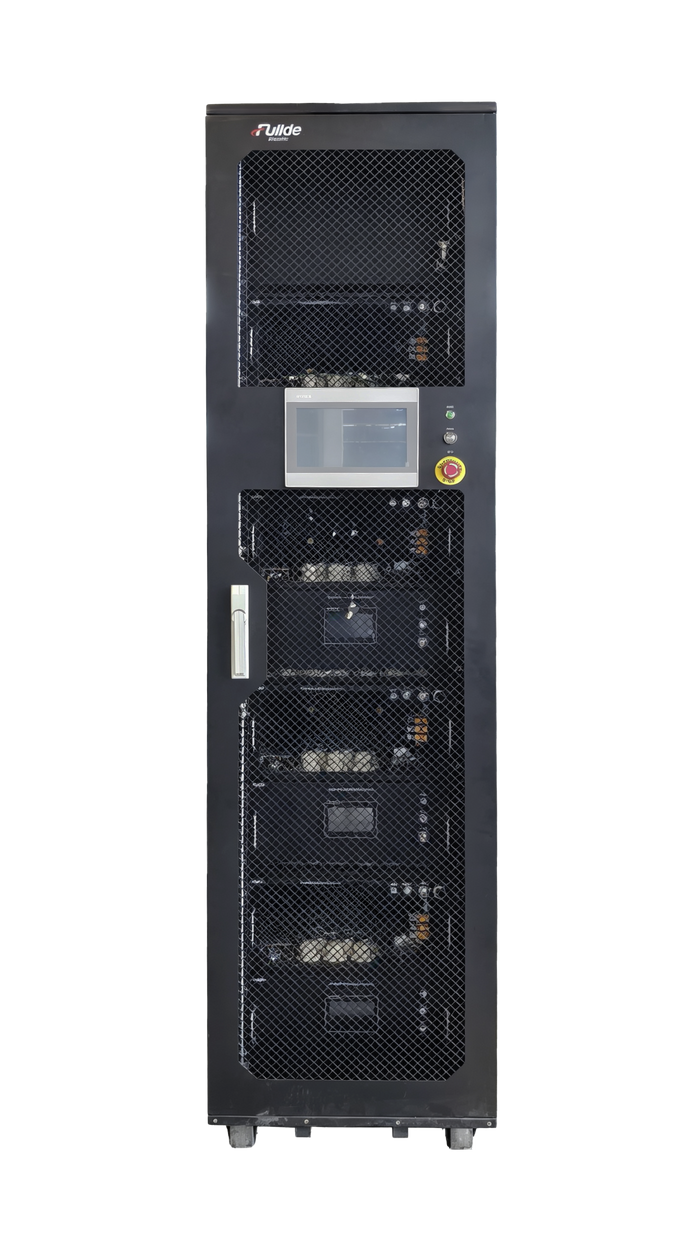
The project deployed LB-216kW-AC415V-J air-liquid hybrid load banks in quantity. This model features a dual-mode architecture combining air-cooled and liquid-cooled modules: the liquid-cooled section connects to the customer's existing cold-plate piping to simulate real GPU thermal dissipation, while the air-cooled section coordinates with the hot/cold aisle containment to independently emulate air-cooled environments.
The core design philosophy can be summarized in three "simultaneities":
- Simultaneous integration – both air-cooled and liquid-cooled modules are housed in the same cabinet, adaptable to scenarios ranging from traditional air-cooled rooms to fully liquid-cooled clusters;
- Simultaneous validation – power distribution and liquid-cooling systems are tested in parallel, with both infrastructure layers loaded simultaneously to more faithfully reproduce actual operating conditions;
- Simultaneous monitoring – all load banks are centrally managed and dispatched from a single supervisory platform, providing real-time acquisition and display of power, voltage, current, inlet/outlet temperature, flow rate, pressure, and other parameters, with automated test curves and report generation.
From measured data on deployed units, under rated flow of approximately 240L/min and supply water temperature around 34°C, each unit operates stably at full load, with temperature rise and flow deviation meeting all acceptance criteria.
---
On‑Site Validation: A Full "Head‑to‑Toe" Examination from CDU to Rack
Testing strictly followed the data center commissioning process and was conducted in three phases:
Phase 1: CDU performance verification. Load banks were connected to the secondary-side liquid piping to simulate GB200 rack heat output at 25%, 50%, 75%, and 100% load factors. At rated flow around 240L/min and supply water temperature around 34°C, the CDU supply‑return temperature differential remained within design limits, and branch flow deviations met acceptance standards.
Phase 2: Rack‑level thermal and simulation correlation. All load banks were synchronously stepped to full power, simulating the thermal distribution of entire rack rows under high‑load conditions. The built‑in intelligent control system monitored multiple parameters in real time – power, current, temperature, flow, pressure – with data uploaded to the customer's monitoring platform for thermal model calibration.
Phase 3: Power distribution stress testing. A single mains failure scenario was simulated – one of the dual UPS feeds was interrupted, and all load banks were transferred to the remaining UPS and static transfer switch (STS). All units were synchronously stepped to full load to verify the dynamic response capability and protection coordination logic of the power architecture.
Multiple successive test runs confirmed that the batch‑deployed air‑liquid hybrid load banks operated stably under high load and high flow conditions, with data accuracy and response speed fully meeting the customer's stringent requirements. The system provided a high‑fidelity heat source simulation for the liquid‑cooling infrastructure, delivering reliable data to support customer decision‑making.
---
Core Value: Why Renting Is Smarter Than Buying?
The rental model adopted in this project is grounded in clear engineering economics:
Cost optimization. A 216kW air‑liquid hybrid load bank is specialised test equipment that typically sits idle after project completion. The rental model converts capital expenditure into operating expense, paying only for what is used.
Speed of response. With a local warehouse and office in Malaysia, Fullde can significantly shorten equipment delivery lead times. In contrast, a procurement model – from tendering and manufacturing to international delivery – typically takes months.
Full‑process technical support. The rental service covers not only equipment but also transportation, installation, commissioning, and on‑site guidance. The customer is not required to staff dedicated operators, lowering the testing threshold and reducing manpower costs.
Equipment reliability assurance. All rental units undergo regular maintenance and calibration, ensuring that every load bank delivered to site is in optimal working condition.
---
Outcomes and Industry Insights
The successful execution of this project offers three replicable lessons for AIDC infrastructure development:
Insight 1: Testing must be performed before production equipment is deployed. Completing end‑to‑end validation of power and liquid‑cooling systems before live GPU servers are installed can uncover design flaws and construction issues early. In this project, load testing helped the customer identify several areas for optimisation in CDU control logic and pipe flow distribution, avoiding costly post‑commissioning rework.
Insight 2: Air‑liquid hybrid architecture is the "master key" for liquid‑cooled data centers. Pure liquid‑cooled load banks cannot simulate air‑cooled environments, while pure air‑cooled units cannot interface with liquid loops. The hybrid design accommodates both cooling modes within the same cabinet, covering test scenarios from traditional air‑cooled rooms to fully liquid‑cooled clusters.
Insight 3: The rental model is better suited to the fast pace of overseas AIDC projects. Cross‑border procurement faces multiple uncertainties – logistics, customs, delivery times. Choosing a supplier with local warehousing and service capabilities, and acquiring test equipment on a rental basis, is an effective strategy to compress project schedules.
---
Conclusion
From rapid local mobilization to stable operation of the batch‑deployed 216kW‑class air‑liquid hybrid load banks, this Malaysian AIDC project validates a fundamental engineering truth: the reliability of compute infrastructure is not "measured" – it is "validated." Conducting a full‑system "mock exam" with load banks between power‑on and server deployment is the optimal solution to replace uncontrollable failure risks with controllable testing costs.
As a national "Specialised and Sophisticated" SME champion, Fullde has built a complete product matrix covering multiple power classes in the air‑liquid hybrid load bank segment, and has established local warehousing and service support in Malaysia. Whether through equipment rental or customised solutions, Fullde is well‑positioned to deliver efficient, reliable test and validation services for AIDC projects across Southeast Asia and worldwide.