
 Cloud & AI Infrastructure
 Dev Ops Live
 Cyber Security World
 Big Data & AI World
 Data Centre World
Exhibitor Press Releases
TuringData Debuts in MLPerf Storage v3.0 with 541.5 GiB/s from a Three-Node Cluster
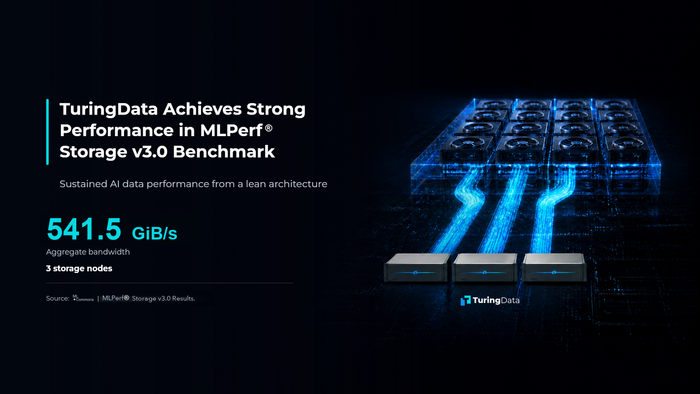
This release covers TuringData’s first results in the MLCommons MLPerf Storage v3.0 benchmark: what a three-node TuringData Flash achieved on AI training and checkpoint workloads, why storage throughput matters for GPU utilisation, and where to meet the team at Tech Week Singapore 2026.
SINGAPORE, 16 September 2026 – TuringData, a Singapore-based AI storage company, today shared its results from MLPerf® Storage v3.0, the MLCommons® benchmark that measures how well storage systems keep AI accelerators supplied with data. In its first submission to the benchmark, a three-node TuringData Flash delivered 541.5 GiB/s of read bandwidth on the 3D U-Net training workload while supporting 96 simulated accelerators.
The same three-node cluster also ran the Checkpoint-70B workload, which measures how fast a storage system can save and restore the state of a 70-billion-parameter model, at 539.9 GiB/s read and 307.1 GiB/s write.
Results at a glance
- 3D U-Net training: 541.5 GiB/s read bandwidth, supporting 96 simulated accelerators
- Checkpoint-70B: 539.9 GiB/s read and 307.1 GiB/s write
- Configuration: three TuringData Flash F9200 storage nodes for both workloads
Why storage performance matters
As GPU clusters grow, storage often becomes the constraint. When data can’t reach accelerators fast enough, GPUs sit idle waiting for input. Checkpointing adds another pressure point: the faster a model’s state can be saved and restored, the less training time is lost to saves and recovery. TuringData’s results show that a compact three-node deployment can deliver high throughput for both training data and checkpoints, without a large storage footprint.
About MLPerf Storage v3.0
MLCommons published MLPerf Storage v3.0 results on 1 September 2026, with submissions from 19 organisations, including 11 first-time submitters such as TuringData. This round added new KV cache and vector database tests, along with support for S3 object storage.
About TuringData Flash
TuringData Flash is AI-native storage appliance built on PCIe 5.0 NVMe SSDs and 400 Gbps InfiniBand or Ethernet (RoCE) networking. They support NVIDIA GPUDirect® Storage, use a distributed, non-volatile metadata architecture, and provide a unified global namespace, per-directory QoS and quotas, and policy-based migration of cold data to object storage. A deployment can be fully operational with three nodes.
Meet TuringData at Tech Week Singapore
Visit TuringData at Tech Week Singapore, 29–30 September 2026, Sands Expo and Convention Centre, Singapore, 5-H10. To book a meeting, go to www.turingdata.io/contact-us.
About TuringData
Headquartered in Singapore, TuringData builds the data layer for AI infrastructure — helping enterprises and AI cloud providers get more from their GPU clusters, maximising GPU utilisation across training and inference and advancing token economics as AI scales.. Learn more at www.turingdata.io.
Media contact
Erin Lu, erin.lu@turingdata.io
Result verified by MLCommons Association. The MLPerf name and logo are registered and unregistered trademarks of MLCommons Association in the United States and other countries. All rights reserved. Unauthorized use strictly prohibited. See www.mlcommons.org for more information. NVIDIA and GPUDirect are trademarks and/or registered trademarks of NVIDIA Corporation in the U.S. and other countries.